
Design & build · Renovation · Engineering · New build — London & Greater London020 4577 0818from the UK+44 20 4577 0818from abroad
Heating · Solar thermal & solar water heating

Solar thermal & solar water heating installation in London

Design and turnkey installation of solar thermal systems for hot water, including evacuated tube (vacuum tube) collectors, solar cylinders and integration with your boiler or heat pump. We survey, design, specify the right equipment, install, commission and hand over.

020 4577 0818Calling from the UK
+44 20 4577 0818Calling from outside the UK
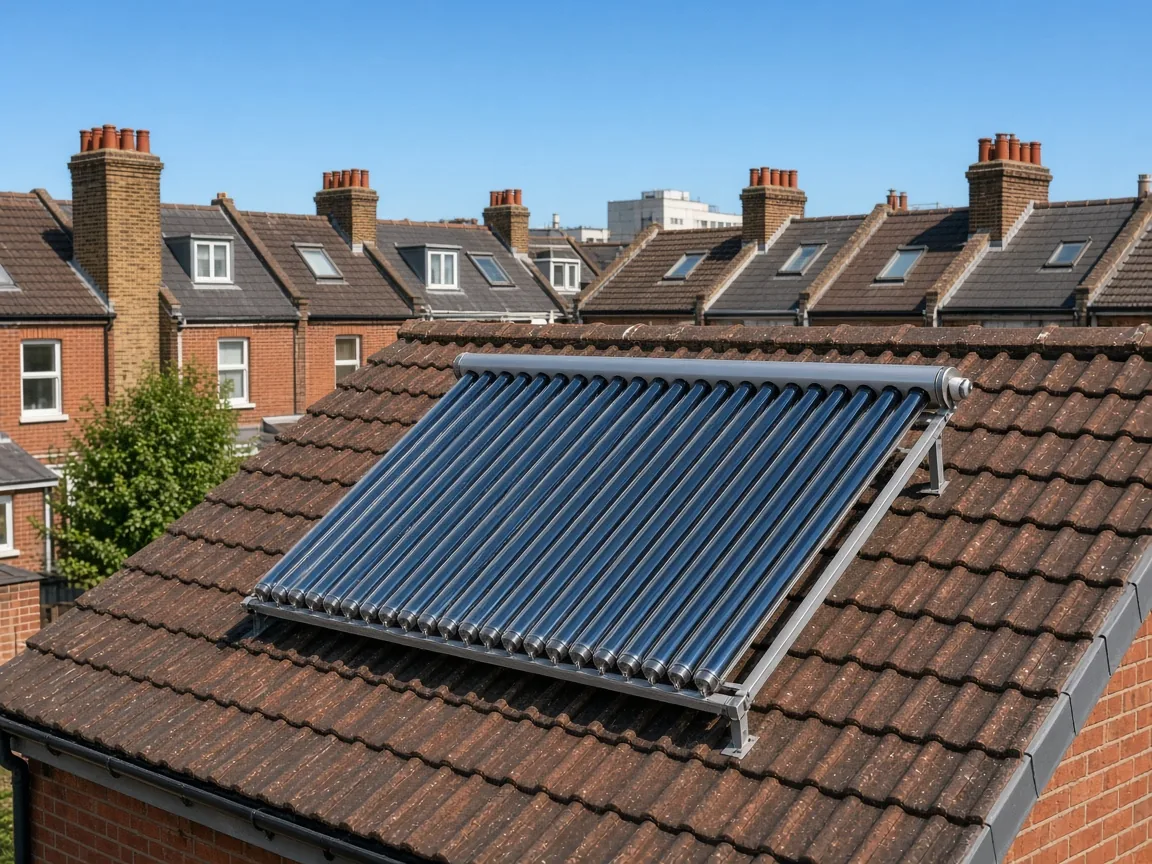
Evacuated tube solar thermal collectors on a tiled roof of a London terraced house
Services

Solar water heating from survey to commissioning

Collectors, cylinder, pipework and controls designed and installed as one system by the same team that handles your plumbing and heating.

Solar water heating design & installation

Complete solar thermal systems designed around your roof and household hot water use: collectors, pipework, pump station, controls and cylinder, installed and commissioned as one system.

  • Survey of roof space, orientation, shading and hot water demand
  • Collector sizing to your use, not just your roof
  • Pipe routes planned and concealed where possible
  • Commissioning, controls set-up and handover pack
Get a free quote

Evacuated tube (vacuum tube) collectors

A bank of glass tubes mounted on the roof, with a vacuum between the layers that limits heat loss. They generally perform better in cold or overcast weather and where roof area is limited.

  • Roof, flat roof frame, wall or ground mounting
  • Around 5 m² of sunlit space is typically needed
  • South-facing, or between east and west, but not north
Get a free quote

Flat plate collectors

A glazed panel with an absorber plate, fixed to the roof tiles or integrated into the roof. A robust, lower-profile alternative when the roof is suitable.

  • On-roof or in-roof fitting
  • Neat appearance in conservation areas where permitted
  • Specified after comparing with evacuated tubes
Get a free quote

Hot water cylinders for solar

Solar heat is stored in a cylinder with a solar coil, or a dedicated solar cylinder. We check what you have and replace or add a cylinder where needed, with the safety devices that go with it.

  • Twin-coil or dedicated solar cylinders
  • Unvented cylinder installation to the Building Regulations
  • Immersion or boiler back-up for the colder months
  • Space and pipe routes surveyed first
Get a free quote

Integration with boilers & heat pumps

Solar thermal normally works alongside a conventional boiler with a cylinder, or a heat pump, which tops up the heat when the sun cannot.

  • Conventional boilers with cylinders
  • Air source heat pumps and cylinders
  • Combi boilers: honest advice on alternatives
  • Controls so the back-up only runs when needed
Heating services

Controls, servicing & aftercare

A solar thermal system needs a thorough check about every five years, with the fluid mix flushed and replaced, and many owners also choose a shorter annual check.

  • Handover walkthrough and written maintenance notes
  • Five-yearly flush and fluid replacement
  • Controller warnings and holiday settings explained
  • Repairs and servicing on existing systems
Get a free quote
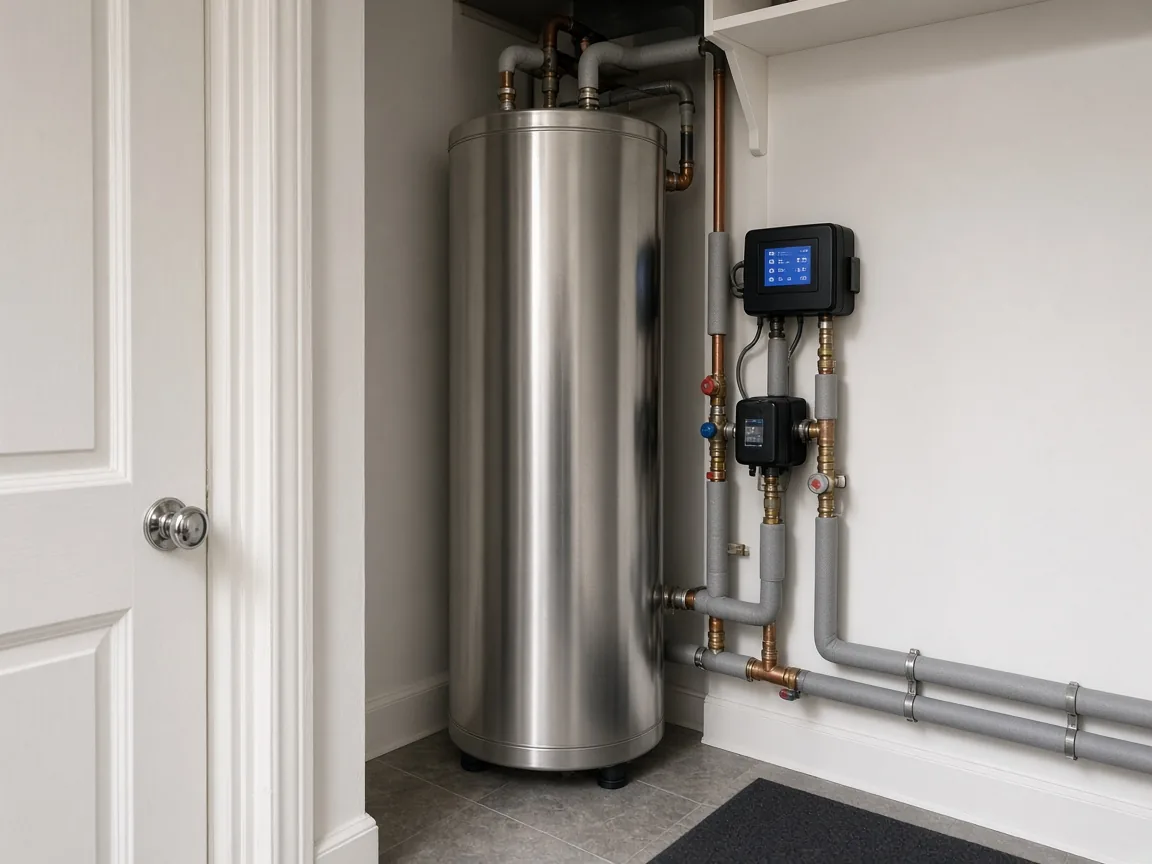
Solar hot water cylinder with pump station and controller in a London utility room
Hot water

How solar water heating works

Collectors on the roof contain a mix of water and antifreeze. The sun heats it, a pump moves it through a coil in your hot water cylinder, and the cooled liquid returns to the roof to be heated again.

Because solar energy varies through the year, a boiler or immersion heater tops up the water, and a properly designed system keeps that back-up from running when it is not needed.

CollectorsEvacuated tubes or flat plate on the roof.
Pump stationCirculates the solar fluid and monitors it.
CylinderA solar coil stores the heat for your taps and showers.
ControlsManage solar, boiler and immersion together.
Thermal or PV?

Solar thermal or solar PV for your roof?

Both use the sun and both need roof space. We help you choose.

When solar thermal suits

It suits homes with high hot water use, a suitable cylinder or space for one, and a roof slope that can host collectors.

  • Large households or heavy hot water use
  • Conventional boiler with cylinder, or a heat pump
  • Limited roof space where evacuated tubes help
Get a free quote

When solar PV may be better

Solar PV generates electricity for the whole home, including hot water via an immersion diverter. It is often the better use of a small roof.

  • Combi boiler homes without a cylinder
  • Homes wanting electricity, EV charging or a battery
  • Roofs where only one system will fit
Solar panel installation

Comparing at the survey

We survey the roof and hot water use, then compare solar thermal and solar PV for your property before you decide. Both can sometimes be fitted if there is enough roof area.

  • Honest comparison for your home
  • Roof layout drawn up for each option
  • Written quote for the option you choose
Get a free quote
How it works

From survey to handover

  1. Survey & design

    We survey the roof, cylinder space and hot water use, and design the system around them.

  2. Specification & quote

    A written equipment specification, itemised quote and programme.

  3. Turnkey installation & commissioning

    We handle the whole job: scaffolding, collectors, pipework, cylinder, controls, testing and commissioning.

  4. Handover & aftercare

    A walkthrough, maintenance notes and support, plus servicing when you need it.

Costs

What affects the cost of solar water heating?

The price depends on the collectors, the cylinder and the roof. These are the main factors, with an indicative published figure.

Collector type

  • Evacuated tubes or flat plate
  • Size of the array
  • Mounting on roof, frame or wall

Cylinder

  • Existing cylinder reuse or replacement
  • Solar coil or dedicated cylinder
  • Space and pipe routes

Roof & access

  • Pitched or flat roof
  • Scaffolding and licences
  • Roof condition or repairs

Funding & running costs

  • No dedicated grant for solar thermal
  • Not funded by the Boiler Upgrade Scheme
  • Periodic servicing

Indicative figure from published UK guidance: a typical solar water heating system costs around £5,300 installed. This is a national typical figure, not a quote. Solar water heating typically provides roughly half of your hot water needs on average, and hot water accounts for around 11% of the average energy bill, so we advise honestly on whether it is the right choice for your home.

Planning & regulations

Planning permission and Building Regulations for solar thermal in London

Solar thermal collectors fall under the same permitted development rules as solar PV in England. We check the position for your property before design.

Houses: roof-mounted systems

In England, solar panels on the roof of a house are generally permitted development, so a planning application is not usually needed, provided the limits are met.

  • Panels or collectors may not protrude more than 0.2 m beyond the roof slope
  • They may not rise above the highest part of the roof (chimneys excluded)
  • On a flat roof the limit is 0.6 m above the highest part of the roof
  • Equipment should be sited to minimise its effect on the appearance of the building and the area
Get a free quote

Conservation areas & listed buildings

London has many conservation areas and listed buildings, and these are where the rules tighten.

  • Conservation area or World Heritage Site: no panels on a wall, balcony or roof enclosure that fronts a highway, although the roof itself is generally still permitted
  • Listed building: permitted development does not apply and listed building consent is needed
  • Article 4 directions and planning conditions can remove permitted development rights, so we check your property before design
Get a free quote

Flats, maisonettes & leasehold

Rules for a block of flats are set out separately in the planning legislation and follow similar limits.

  • Leaseholders normally need the freeholder’s consent, because the roof usually belongs to the building owner
  • Listed blocks of flats are excluded from permitted development
  • Shared roofs, access and electrical supply arrangements are agreed before design is finalised
Get a free quote

Building Regulations

Hot water cylinders and their safety devices fall under the hot water safety requirements of the Building Regulations (Part G), new electrical work such as pump and controller wiring must comply with Part P, and the roof must be able to carry the added load (Part A).

  • Roof loading and fixings are checked before collectors are specified
  • Cylinder, controls and safety devices are installed and commissioned as a complete system
  • You receive the commissioning records and manuals at handover
Get a free quote
Typical scenarios

Typical solar thermal projects in London

These are typical situations we plan for, not named client projects.

Family home with a conventional boiler

A house with a boiler and a cylinder is often the easiest case: collectors on the south or west slope, a solar coil in a new or existing cylinder, and the boiler as back-up.

  • Existing cylinder checked first
  • Pipe route to the roof planned
Get a free quote

Home moving to a heat pump

A new cylinder is needed anyway, so solar pre-heat can be designed in from the start. The heat pump must still meet the heating demand on its own.

  • Cylinder sized for both heat sources
  • Controls arranged to prefer solar heat
Get a free quote

Combi boiler terrace

Solar thermal rarely fits a combi home without changes. We may recommend solar PV or a different hot water arrangement instead.

  • Honest advice on alternatives
  • No collectors where they do not make sense
Get a free quote

Renovation with a new roof or extension

Pipework is easiest to run before ceilings are closed, and scaffolding is already up for roof work.

  • Collectors and cylinder planned in the design
  • Pipe routes built in during first fix
Get a free quote
FAQ

Solar thermal and solar water heating: FAQs

What is solar thermal, and how is it different from solar PV?

Solar thermal, also called solar water heating, uses collectors on the roof to heat water in a cylinder. Solar PV panels generate electricity. The two look similar from the street but do different jobs, and they compete for the same roof space.

What is the difference between evacuated tube and flat plate collectors?

Evacuated tube collectors use a bank of glass tubes with a vacuum that limits heat loss, so they generally perform better in cold and overcast conditions and where roof space is limited. Flat plate collectors are a glazed panel fixed to or built into the roof; they are robust, with a lower profile. Evacuated tubes usually cost more. We recommend one after a survey of your roof and hot water use.

How much does solar water heating cost?

Published UK guidance puts the cost of a typical solar water heating system at around £5,300 installed. That depends on whether you choose evacuated tubes or flat plate collectors, the size of the system, whether your cylinder needs replacing, and roof access. We give you an itemised written quote after the survey.

How much hot water will solar thermal provide?

Solar water heating systems typically provide roughly half of a home’s hot water needs over a year. In summer they can provide around 90% of your hot water, falling to around 25% in winter, so a boiler or immersion heater tops up the rest.

Do I need a new hot water cylinder?

Usually you need a cylinder designed for solar heating, with a coil for the solar loop, or a dedicated solar cylinder. If you have a conventional boiler with a cylinder, we check whether it can be reused or should be replaced. We also need space to house the cylinder and a route for pipework from the roof.

Will solar thermal work with my combi boiler?

Few combi boilers are compatible, because they do not heat water in a cylinder. In most combi homes you would need a solar cylinder and to replace the boiler with a conventional boiler or heat pump. If you have a combi, we will tell you honestly whether solar thermal or solar PV makes more sense.

Can solar thermal be used with a heat pump?

Yes. A solar thermal system can pre-heat the hot water cylinder so the heat pump or boiler has less to do. Solar thermal systems generally supply hot water only, not space heating. Under the Boiler Upgrade Scheme the heat pump itself has to meet the home’s heating demand, so the solar thermal system is not counted towards that.

Do I need planning permission for solar thermal collectors?

Solar thermal collectors fall under the same permitted development rules as solar PV in England. Roof-mounted collectors on a house generally do not need planning permission if they stay within the limits, but listed buildings, conservation area walls and balconies that front a highway, flats and Article 4 areas need extra checks. We confirm the position before design.

Are there grants for solar water heating?

There are no dedicated grants for solar thermal, and the Boiler Upgrade Scheme does not fund it, so the cost is normally met by the homeowner. We give you an itemised written quote so you can weigh the cost against the hot water savings.

How is a solar thermal system maintained?

You should be given written maintenance notes at handover. The system should be checked thoroughly about every five years, with the system flushed and the fluid mix replaced. A shorter annual check is optional. Leave it running while you are on holiday and use any holiday function on the controller.

Does solar thermal work all year in London?

Yes, it works through the year, but output varies with the season, so it does not meet all of your hot water needs, especially in winter. Collectors work on diffuse daylight as well as direct sun. They work best on a south-facing roof, or between east and west, but not north-facing.